Match the light to the catalyst.
Consider the wavelength, catalyst response and illuminated surface area. Lamp placement and shadows influence where light reaches the material.
Technology explained / From principles to applications
What is a photocatalyst? Why does UV wavelength matter? Explore how light, materials, filtration and airflow work together in air purification module development.
01 / What is a photocatalyst?
A photocatalyst is a material that helps a chemical reaction take place when it receives suitable light. Titanium dioxide (TiO₂) is a widely studied example for air treatment.
In photocatalytic air treatment, light can activate the catalyst surface. Reactions involving oxygen and moisture can form reactive species that interact with certain pollutants reaching that surface. [1]
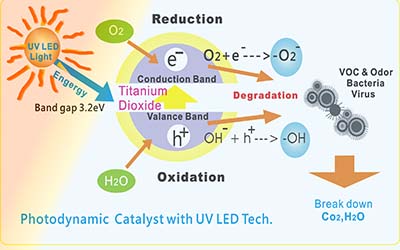
How to read the diagram
The CO₂/H₂O endpoint represents idealized complete oxidation of suitable organic pollutants. It does not mean every pollutant is fully converted, or every microorganism is inactivated. Intermediate products and real operating performance must be evaluated. [1]
02 / UV LED & wavelengths
Wavelength describes the light emitted, in nanometers (nm). A UV band is a category, not a product specification or a guarantee of effectiveness.
| UV band | Wavelength range | Role in a module | What needs to be checked |
|---|---|---|---|
| UVA | 315–400 nm | Can be used to activate suitable photocatalyst materials. The material and light source must be matched. | Catalyst response, optical output, surface illumination, geometry and thermal conditions. |
| UVB | 280–315 nm | Included here to explain the UV spectrum. It is not listed as a SEIYA offering on this page. | Any proposed use requires a separate application and safety assessment. |
| UVC | 100–280 nm | Used in engineered UV disinfection applications. Inactivation depends on wavelength and the UV exposure delivered. | Target organism, irradiance, exposure time, coverage, shielding and accessible UV exposure. |
UV band ranges follow CDC classification. These broad ranges are not the emission range of a single LED. [2, 3]
03 / How a module comes together
Light, materials, filters and airflow have distinct roles. Their arrangement is developed around the available enclosure and the intended application.
Consider the wavelength, catalyst response and illuminated surface area. Lamp placement and shadows influence where light reaches the material.
Particle filters capture particles; gas-treatment media address different targets. Select the media and maintenance approach for the application rather than treating every filter as interchangeable.
Fan selection, flow distribution, pressure drop and residence time influence the design. More airflow does not automatically mean better treatment per pass.
Plan for available space, power, thermal management, noise, assembly and service access. For UV applications, consider shielding and access controls as part of the enclosure design.
04 / Where can it be applied?
SEIYA's experience includes vehicle purification modules, air outlet modules, customized products and UV LED disinfection development.
Development experience
Modules developed for vehicle-related air purification applications.
Integration discussion
Available space, power supply, fan noise, mounting location and the air path through the module.
Development experience
Modules developed for integration at air outlets and in air-conditioning applications.
Integration discussion
Outlet dimensions, airflow resistance, illumination geometry, installation access and cleaning or replacement needs.
Custom development
Discuss module integration into a partner's appliance or a new product concept.
Integration discussion
Target pollutants, enclosure layout, airflow, filter arrangement, noise and the evaluation method for the finished product.
Development experience
Product development using UV LED technology for a defined disinfection application.
Integration discussion
Target surfaces or treatment zones, exposure geometry, UV dose, shielding and verification of the intended use.
Field experience in Taiwan
SEIYA has more than a decade of product application experience in settings including hospitals and government facilities, with designs progressively improved through field use. These settings describe application experience; they do not establish a universal performance rating or institutional endorsement.
05 / Turning a concept into a validated design
Define the target pollutant or microorganism, intended environment, airflow and use pattern before comparing test results.
Agree on test conditions, sampling, exposure time and acceptance criteria. A material test does not establish the performance of a finished appliance.
Evaluate potential reaction byproducts and emissions alongside treatment results. Photocatalytic oxidation may create intermediate compounds; complete removal should not be assumed. [1]
Direct UVC exposure can injure eyes and skin. Review enclosure shielding, access during servicing and any required interlocks for the finished design. [3]
Frequently asked questions
No. Photocatalysis relies on light activating a catalyst and the resulting surface chemistry. UVC disinfection relies on UV exposure delivered to microorganisms. A product may combine approaches, but their roles and test requirements should be defined separately.
No. Performance depends on the target, material response, light output, exposure conditions and system design. Wavelength alone is not enough to compare two modules.
No universal claim is made. Different gases and odors respond differently, and real performance depends on the configuration and operating conditions. Define the target compounds and test the proposed design.
Share your product type, target market, available dimensions, power supply, airflow or fan information, intended treatment goal and any existing test requirements. We can then discuss OEM, ODM or co-development scope.
These sources explain general technology. They are not SEIYA product certifications or test reports.
OEM / ODM / Co-development
Tell us your application, target market and integration needs. We can discuss the appropriate module and development scope together.